

Il cinema tedesco occidentale in Italia (1949-1989)
14 Settembre 2024
Digitisation of the cultural heritage of minority communities for equity and renewed engagement
14 Settembre 2024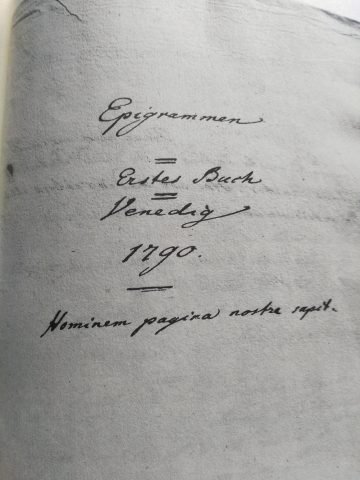
Goethes Venezianische Epigramme
Componenti
Collaborazioni
Descrizione
Goethes Venezianische Epigramme – Kritische digitale Edition is an innovative research project in collaboration with the BemboLab, the Venice Centre for Digital and Public Humanities of Ca’ Foscari University of Venice, the Goethe- und Schiller Archiv and the Stuttgart Research Center for Text Studies.
Goethe’s Venetian Epigrams have survived in many manuscript versions, of which there is as yet no critical edition. Due to the lack of a reliable author’s last will, the interweaving of censorship and self-censorship and the impossibility of establishing a stabile copy-text within the ever-changing flux of the work, the complicated history of Goethe’s Venezianische Epigramme eludes every fixed philological approach, forcing the observation of the authorial shift that happens at each and every stage of their diachronic movement.
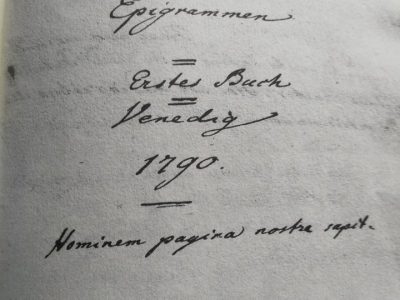
Starting from the photographic reproductions of each witness (H 54, H 54a, H 56, H 61, H 55, H 57, H 59) a new topographic-diplomatic transcription and a reconstruction of Goethe’s workflow through the analysis of his intricate microgenetic process, our critical digital edition aims not only to offer a synoptic picture of the different versions of the whole collection as well as of every single epigram, but also to engage new ways to digitally represent a ‘text in motion’.
The user will be allowed to explore the epigrams by means of a vertical synoptic representation of each verse in its different compositional stages (with regard to both the intradocument and the interdocument variants), a horizontal synoptic constellation of every stage of a single poem, and finally a rendition of the text’s metamorphosis (textum mobile). The flux of constants and variants will be made visible by the actual movement of the diplomatic transcription from one witness to the other, with the possibility of color-coding autographic and allographic variants in the process. The same rendition will be further extended to the collection in its entirety, allowing thus to display the constant movement of every epigram’s collocation within the different witnesses.
On the data side we aim to design and implement models capable of representing and rendering a set of texts at different granularity levels, ranging from word or word portions to lines, epigrams, and collections. Variants branch from each unit in an apparently chaotic efflorescence. At the most granular level of detail, we must be able to represent all these data and their relationships in a structure capable of conveying data about both the text and its graphical appearance on the sheet. The data model and a corresponding software tool will be developed on a higher abstraction and generalization level, thus making it a candidate for reuse in similar scenarios.
Our activities are inextricably linked with the monumental project of a comprehensive critical edition of Goethe’s work (Neue Weimarer Ausgabe), which is being undertaken at the Klassik Stiftung Weimar. Our findings will be shared with the editors of the first volume of the edition, which concerns Goethe’s poetry. (https://goethe-lyrik.net/). Our team is also collaborating with the DiScEPT project of the IISG and will work at a critical edition of the Venezianische Epigramme especially design for the platform.
Eventi
Ultimo aggiornamento 14 Settembre 2024 a cura di Ilaria Baldini
